Wednesday, December 31, 2008
AA & 12-Step Classes Schedule
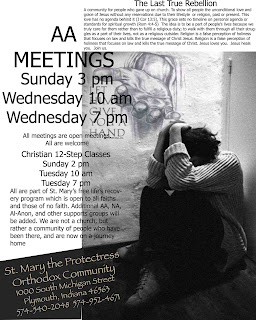
AA Meetings: Sunday 3 pm; Wednesday 10 am; Wednesday 97 pm
This are open meetings and all are welcome.
Christian 12-Step Classes: Sunday 2 pm; Tuesday 10 am; Tuesday 7 pm
These classes are open to all no matter what faith or no faith.
These are part of St. Mary’s free life’s recovery program which is open to all faiths and those of no faith. Additional AA, NA, Al-Anon, and other support groups will be added. If at least two people are interested in any area at any time, the group will be started. We have already have already been asked to start an Al-Anon group during the morning hours. There is also been interest for a group for caregivers during the day. If you have any interest or need more information, please contact the church at either 574-540-2048 or 574-952-4672.
During the day the community will be open as a day drop in center for assistance and study and prayer. We keep the coffee on and most time there is homemade soup and bread. Father Theodosius is available to meet with those in need or hurting.
We can also use your help. Those interested in volunteering some time, please call the church. Also, we need additional recovery material. If you have some extra AA, NA, Al-Anon, or other materials, we can put it to use. A well worn Big Book works just as good as a new one. That extra Bible you have that is not being used, can be read by someone here. This program is free and open to all. So if you would like to donate a $1.29 (or more) to help us, please do.
St. Mary’s Orthodox Community is a community of people who had given up on church. We are a community of people who have been there, and are now on a journey home. The community works hard to show all the unconditional love and grace of Jesus without any reservations due to their lifestyle or religion, past or present. This love has no agenda behind it (1Cor:13-5). This grace sets no timeline on personal agenda or standards for spiritual growth (Rom 4:4-5). The simple idea is to be a part of people’s lives because we truly care for them rather than to fulfill a religious duty; to walk with them through all their struggles as a part of their lives, not as a religious outsider. For this community, religion is not a false perception of holiness that focuses on law and kills the true message of Christ Jesus. Jesus loves you. Jesus heals you. We invite you to join us.
We invite you to join us in how ever you are comfortable and for what ever your need. In addition to the AA meetings and 12-Step Classes, there are daily worship services. The Holy Qurbana is celebrated every Sunday starting at 10 am.
Join us Saturday for prayers for Gaza
This Saturday St. Mary's Orthodox Community, 1000 South Michigan Street,
Plymouth, Indiana, will celebrate a special prayer service at the community
for peace and justice in Gaza and the rest of the Holy Land as suggested by
the heads of the Christian Churches in Jerusalem. The Saturday service will
be celebrated starting at 10 am. Father Theodosius asks that those who are
unable to join them, to raise their voices and prayers with them, wherever
they are at the time. The service will be repeated following the Holy
Qurbana on Sunday. The Sunday Holy Qurbana starts at 10 am. The community¹s
pastor, Father Theodosius Walker also suggested that there should be a time
of fasting in the days before the prayer services. According to Father
Theodosius there is great power in fasting and prayer.
Yesterday the Patriarchs, Bishops and the Heads of Christian Churches in
Jerusalem issued a statement calling for prayers for peace and justice in
Gaza this Saturday. In the words of these Holy Land bishops "...we raise
our prayers to the Child in the manger to inspire the authorities and
decision makers on both sides, the Israelis and Palestinians, for immediate
action to end the current tragic situation in the Gaza Strip. We pray for
the victims, the wounded and the broken-hearted. May the Lord God Almighty
grant all those who have lost loved ones consolation and patience. We pray
for all those living in panic and fear, that God may bless them with calm,
tranquility and true peace."
The St. Mary the Protectress Orthodox Community is under an allegiance to
the hierarchy of the Universal Syrian Orthodox Church under His Holiness
Ignatius Zakka I Iwas. St. Mary the Protectress Orthodox Community is
located at 1000 South Michigan Street, Plymouth, Indiana. For more
information, please contact the pastor Father Theodosius Walker at (574)
952-4671.
Tuesday, December 30, 2008
Saturday Prayer service
prayer service at the church for peace and justice in Gaza and the rest of
the Holy Land as suggested by the heads of the Christian Churches in
Jerusalem. If you are unable to join us, please raise your voices and
prayers with us. The services will be repeated following the Holy Qurbana
on Sunday. Perhaps in the days before this we can have a time of fasting.
There is great power in fasting and prayer.
In the words of these Holy Land bishops" "...we raise our prayers to the
Child in the manger to inspire the authorities and decision makers on both
sides, the Israelis and Palestinians, for immediate action to end the
current tragic situation in the Gaza Strip. We pray for the victims, the
wounded and the broken-hearted. May the Lord God Almighty grant all those
who have lost loved ones consolation and patience. We pray for all those
living in panic and fear, that God may bless them with calm, tranquility and
true peace."
Statement on Gaza
Statement by the Patriarchs and Heads of the Churches in Jerusalem
On the current devastating situation in Gaza
We, the Patriarchs, Bishops and the Heads of Christian Churches in Jerusalem, follow with deep concern, regret, and shock the war currently raging in the Gaza Strip and the subsequent destruction, murder and bloodshed, especially at a time when we celebrate Christmas, the birth of the King of love and peace. As we express our deep sorrow at the renewed cycle of violence between Israelis and Palestinians and the continued absence of peace in our Holy Land, we denounce the ongoing hostilities in the Gaza Strip and all forms of violence and killings from all parties. We believe that the continuation of this bloodshed and violence will not lead to peace and justice but breed more hatred and hostility - and thus continued confrontation between the two peoples.
Accordingly, we call upon all officials of both parties to the conflict to return to their senses and refrain from all violent acts, which only bring destruction and tragedy, and urge them instead to work to resolve their differences through peaceful and non-violent means. We also call upon the international community to fulfill its responsibilities and intervene immediately and actively stop the bloodshed and end all forms of confrontation; to work hard and strong to put an end to the current confrontation and remove the causes of conflict between the two peoples; and to finally resolve the Israeli-Palestinian conflict with a just and comprehensive solution based on international resolutions.
To the various Palestinian factions we say: It is time to end your division and settle your differences. We call on all factions at this particular time to put the interests of the Palestinian people above personal and factional interests and to move immediately toward national comprehensive reconciliation and use all non-violent means to achieve a just and comprehensive peace in the region.
Finally, we raise our prayers to the Child in the manger to inspire the authorities and decision makers on both sides, the Israelis and Palestinians, for immediate action to end the current tragic situation in the Gaza Strip. We pray for the victims, the wounded and the broken-hearted. May the Lord God Almighty grant all those who have lost loved ones consolation and patience. We pray for all those living in panic and fear, that God may bless them with calm, tranquility and true peace.
We call on all to observe next Sunday, January 4, as a day for justice and peace in the land of peace.
+ Patriarch Theophilos III, Greek Orthodox Patriarchate
+ Patriarch Fuad Twal, Latin Patriarchate.
+ Patriarch Torkom II, Armenian Apostolic Orthodox Patriarchate.
Fr. Pier Battista Pizzaballa, ofm, Custody of the Holy Land
+ Anba Abraham, Coptic Orthodox Patriarchate.
+ Archbishop Swerios Malki Mourad, Syrian Orthodox Patriarchate.
+ Abune Matthias, Ethiopian Orthodox Patriarchate
+ Archbishop Paul Nabil Sayyah, Maronite Patriarchal Exarchate.
+ Bishop Suheil Dawani, Episcopal Church of Jerusalem & the Middle East.
+ Bishop Munib Younan, Evangelical Lutheran Church in Jordan & the Holy
Land.
+ Bishop Pierre Malki, Syrian Catholic Patriarchal Exarchate
+ Bishop Youssef Zre'i, Greek Catholic Patriarchal Exarchate.
Fr. Raphael Minassian, Armenian Catholic Patriarchal Exarchate
Jerusalem on 30 December 2008
-
Sunday, December 28, 2008
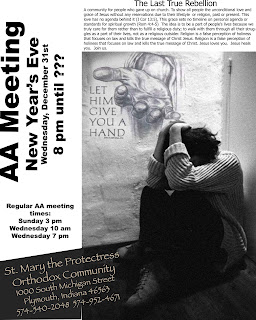
Join us New Year's Eve For AA Meeting
Below is the news release which went out recently which more about New Year’s Eve’s AA meeting and the expanded program. If you can not join in our fellowship, pleas pray for us.
St. Mary the Protectress Orthodox Community in Plymouth, Indiana, will kicked off its expanded recovery program New Year’s Eve with a AA meeting starting at 8 pm and lasting until the last person leaves. This is the start of the parish’s commitment to offer free recovery services and programs to those living in Northern Indiana.
Besides regular AA and NA meetings, 12-Step classes will be offered during the day and evening. There is also all day drop in center at the community for those working their recovery Monday through Friday. Currently, AA meetings are held on Wednesdays at 10 am and 7 pm. There is also a meeting at 3 pm on Sundays. The parish is committed to hold 12-Step support meetings seven days of the week, on any day there are two people wanting a meeting. All meetings are open meetings. Those attending do not need to be Christian or of any faith at all. All are welcome.
The all day drop in center at the church will help people working their recovery providing them a place to meet and talk and find support with all issues.
The community’s pastor, Father Theodosius stressed that a person does not have to be Christian or of any faith or religion to take part the program or any of the community’s recovery services. He said that it is merely the community’s desire to live their faith and to show all people the unconditional love and grace of God without reservations due to their lifestyle or religion past or present. The idea is to be part of people’s lives because we truly care for them rather than to fulfill a religious duty. According the Father Theodosius, we walk with them through all their struggles as part of their lives, not as a religious outsider, but as one who has been there ourselves. He said that religion too often becomes a false perception of holiness that focuses on law and kills the true message of Jesus Christ. Jesus called us to live our lives a certain way. That is the goal of the community and the goal of the recovery program.
The program is helped and staffed by volunteers and Father Theodosius. Father Theodosius has over 15 years in recovery and has also been a counselor working with additions and abuse survivors. Those wishing to help are invited to contact the community. All the volunteers in this program are those who wish to live their recovery in all ways, to take the message they have learned and give it to others. Father Theodosius pointed out that all of us are the Prodigal Son come home and wishing to help his older brother in the door also. He said we live our recovery by our example to our brothers and sisters.
The community is under an allegiance to the hierarchy of the Universal Syrian Orthodox Church under His Holiness Ignatius Zakka I Iwas. St. Mary the Protectress Orthodox Community is located at 1000 South Michigan Street, Plymouth, Indiana. For more information, please contact the pastor Father Theodosius Walker at (574) 952-4671.
Saturday, December 27, 2008
Massacre in Gaza
------ Forwarded Message
From: Maria Khoury <khourymaria@hotmail.com>
Date: Sat, 27 Dec 2008 14:57:45 -0500
To: webpage taybeh church <saint-george-taybeh@saintgeorgetaybeh.org>
Subject: [Saint-george-taybeh] Massacre in Gaza
Christ is Born! Glorify Him!
Dear Friends of Saint George Taybeh,
Just wanted to let you know the following information in case you do not see it on your local news today
since more than 200 people were killed within two hours and more than 400 injured
let us pray that people will come to the Light of Christ, maria
---------
Please forward to media immediately and pick-up the phone and call media outlets immediately to condemn the atrocities being committed in Gaza (Using US taxpayer money and International and Arab Government Acquiescence). Demonstrations are ongoing throughout the West Bank. Here is the press release for the one in Bethlehem
A demonstration to condemn the massacres being committed in Gaza
Palestinian Civil Society organizations in the Bethlehem area, people of various political affiliations, Christians, and Muslims, and all people of conscience in the Bethlehem area are gathering at 5 PM in front of the Church of Nativity and Omar's mosque in Bethlehem.
Nearly 200 people were reported massacred so far by Israeli war planes bombings of the besieged Gaza strip. Hundreds were reported injured so far. The victims include men, women, and children and the number of victims are expected to rise rapidly. Join us today as we call for ending the massacres, ending the siege on Gaza, for reconciliation between all Palestinians, and for freedom.
For more information:
Khalid AlAzza 0545439263
Dr. Mazin Qumsiyeh 0598939532
Dr. Abdelfattah Abusrour 0599255573
-
Israeli siege takes toll on Gaza Christians
http://news.xinhuanet.com/english/2008-12/25/content_10559703.htm
Israeli siege takes toll on Gaza Christians
www.chinaview.cn 2008-12-25 22:51:20
by Saud Abu Ramadan
GAZA, Dec. 25 (Xinhua) -- When Christians all over the world rushed to churches for Christmas midnight mass, some 300 followers of the small Roman Catholic community in the Gaza Strip gathered at the Holy Family School in Gaza for a silent ceremony.
"This year, Christmas comes under a siege without anything supportive. No cloths, no shoes, no food and no gifts due to the (Israeli) blockade and the hard economic situation," said Gaza Latin Church pastor Manuel Musallem.
Israeli sanctions on the Gaza Strip, aimed at isolating the Islamic Hamas movement, have taken toll on the Christian community in the Gaza Strip, home to a total of 1.4 million largely aid-dependent residents.
The tiny Christian community in Gaza called off the midnight mass to protest Israel's blockade and show their solidarity after Israel prevented most of them from traveling to the Church of Nativity in the West Bank city of Bethlehem, the birth place of Jesus Christ.
About 4,000 Christians live in the besieged Gaza. Most of them belong to the Greek Orthodox Church, while the rest follow the Latin Church Christmas calendar, which falls on Dec. 25.
According to sources, about 900 Orthodox and Catholic followers applied to travel to Bethlehem from Gaza, but only 280 were granted permission, or less than a third.
"I would have been very happy if only few monks and families attended this gathering while the other majority could make it through to the cradle of Jesus in Bethlehem," Musallem.
"Those who remain silent and don't shout in the face of the world: Yes to life, No to death, can not be human beings," Musallem said.
The silent ceremony at the Holy Family School was held in candle lights due to electricity shortage caused by the Israeli sanctions.
Instead of serving chocolates, strawberry was distributed to the participants to deliver support to local farmers who found their products unable to be exported to European markets.
Israel imposed the blockade on Gaza last year after the Islamic Hamas movement seized control of the coastal territory from security forces loyal to moderate Palestinian President Mahmoud Abbas.
In June 2008, Israel eased the sanctions after Egypt brokered a ceasefire between the Jewish state and Palestinian militant groups led by Hamas.
But since early November, Israel restored the tight restrictions after the ceasefire was rocked by a resumption of violence. The lull expired on Dec. 19.
Fouad Ayyad, 28, was denied permit to leave the Gaza Strip. "I miss the holy city and want to pray in the Church of Nativity and see my relatives who live there," he said.
Last year, the Israeli intelligence told Ayyad that he would get the permission to the West Bank if he cooperates with them by providing information from Gaza.
"I rejected their offer and still wait for the permission," he said.
Friday, December 26, 2008
Eastern Orthodoxy for Western Christians
James R. Payton Jr., author of "Light from the Christian East: An Introduction to the Orthodox Tradition," discusses his own study of Orthodox theology and how he explains Eastern Christianity to Western Christians. Also, Fr. John McGuckin, an expert in the writings of the Early Church Fathers, on the power of the Jesus Prayer and how the teachings of the Ancient Church can illuminate life in the modern word.
Thursday, December 25, 2008
Genocide in India
The most important thing for us in America to do is to raise awareness about this horrific situation. You may feel as though you have nothing to offer, but you CAN DO SOMETHING. We have the opportunity to give these victims a voice when their voices are being silenced.
Matthew 5:10
"Blessed are those who are persecuted for righteousness' sake, for their's is the kingdom of heaven."
Indian Christians at risk
The violence erupted in August, following the murder of a prominent Hindu priest.
Al Jazeera's Kamal Kumar reports from a camp in Kandhamal, the district at the eye of the storm.
[Saint-george-taybeh] Christ is Born! Glorify Him!
Glorify Him!
This is the 41st year that Christians in Bethlehem celebrate Christmas under Israeli occupation.
Let us remember to pray for peace for the whole world and especially
for Bethlehem, the birthplace of our Lord and Savior.
The Greek Orthodox Christmas Liturgy will be celebrated
in thirteen more days according to the Old Julian Calendar.
As I am shopping, eating and entertaining my three college children in Boston,
it is so easy to forget the extreme humanitarian crisis in Gaza,
although I have tried to raise awareness of these crimes against humanity
and bring more support for our Taybeh projects in solidarity of
our Christian presence in the Holy Land by visiting fifteen churches
and six university classrooms in the last six weeks.
Thank you for your prayers.
This Holy Christmas season, the Israeli army allowed only 300 Christians
to have permits to visit their families in the West Bank.
Please give glory to God for all of your blessings
and seek your salvation. I hope you will have a most blessed and holy Christmas celebration.
“For unto you is born this day in the city of David a Savior, which is Christ the Lord.” (Luke 2:11)
With sincere good wishes in Christ, maria
Tuesday, December 23, 2008
FW: [SOCM-FORUM] Christmas message of Patriarch Moran Mor Ignatius Zakka I Iwas
Ignatius Zakka I Iwas
Patriarch of Antioch and All the East
Supreme Head of the Universal Syrian Orthodox Church
No.E255/08
12-December-2008
Apostolic Benediction to our beloved Metropolitans and to our beloved
spiritual children: the Reverend Vicars and the Parishioners of all
our Malankara churches and congregations in the Arabian Gulf Region,
Europe, Australia and Singapore.
By the Mercy of God, we have once again come to the Feast of the
nativity of our Lord and Saviour Jesus Christ and we have great joy
in sending you this message on this blessed occasion. At the birth of
Jesus, the wise men came from far off places by suffering all the
pains of the difficult journey to see him and to get blessed by this
child who is born as the Saviour of the world. "They saw the child
with Mary his mother, and they fell down and worshiped him. Then,
opening their treasures, they offered him gifts, gold and
frankincense and myrrh" (Matthew 2:11). At this Christmas time we
also have to submit to Him the most valuable that we have. But He is
God and He came to this world in search of the lost sheep ˆ the human
kind. St. Paul says "Do not be conformed to this world but be
transformed by the renewal of your mind, that you may prove what is
the will of God, what is good and acceptable and perfect" (Romans
12:2). So the most valuable and acceptable gift that we can offer Him
is nothing other than ourselves ˆ our soul and our entirety. When we
submit ourselves to Him, we shall follow His path truly and
sincerely. Thus we will be transformed to the true image of God. As
we celebrate this Christmas, let us rededicate ourselves to Him and
turn to be the true followers of Him. May the baby Jesus grow through
our lives and we be the bearers of Him.
Our dearly beloved, we pray that May the coming New Year also be a
year when through each of you, the qualities of Jesus Christ are
being truly revealed to the world, and testifying Him through your
lives. Then, through each of us the world will see the light of God
and receive the peace of Christmas. We wish you all a Merry Christmas
and an evermore blessed New Year. This celebration may bring peace
and spiritual happiness to your churches, homes, and to all your
endeavours.
We extend our Apostolic Blessings to you. May the Grace of God be
with you all through the intercession of St. Mary the Mother of God,
St. Joseph the Righteous and all the other Saints. Amen.
Copy of the Apostolic Encyclical is available at
http://www.socmnet.org/Bull_HH/08_255_HHs_Xmas_Message.pdf
Christmas message from Catholicose Aboon Mor Baselious Thomas I
Let's thank god for giving us an opportunity to commemorate the birth
of Jesus Christ our savior. Christmas is the time of happiness and
celebration all over the world. The celebration has become a business
for the people in the modern world. In the midst of celebrations, the
spiritual meaning of the birth of Jesus Christ has often been
forgotten. In true sense, Christmas is the celebration of Life. The
birth of Jesus Christ reveals the life giving God's involvement in
history. Verses John 10.10 gives the great message of birth of Jesus
Christ. "I have come that they might have life, and they might have
it more abundantly." In this verse lord has given us the purpose of
His coming. Jesus Christ was born in this world to give His life for
all.
Life is an important subject in the Holy Bible it is used more than
35 times in the gospel of St. John. In the holy bible, life is
considered as the gift of God because the base of nature and life is
God himself. In Old Testament God is represented as a living god.
(1st Samuel 17: 26 to 36) The concept of living God clearly assures
us the fact that God provides life. Only God can provide life and
sustain it.
The incarnate birth of Jesus testifies that the living God dwelt
among us. The living God of Old Testament is completely seen in
Jesus. Jesus Christ makes the subject more clear in St. John 14:6 "I
am the way the truth and the life"
Jesus Christ provides life by fighting against all the evil forces.
The purpose of god's kingdom is re-construction of life. The ministry
of Jesus Christ displays that all the obstacles were taken away to
keep life in its fullness. St. Like 4:18, 19 clearly gives the
message of the birth of Jesus Christ and that all facts that object
life is revealed and given to men.
The Christmas celebration of this year is an invitation for all of us
to be a part in Gods ministry for providing life .Many lives are
being aborted due to the reformation of world economy and
consumerism; it is the main hindrance for the prosperous growth of
man's life in this modern society. This truth reinforces that
abortion is an act against God himself.
Today not only is man's life but also nature's existence in danger.
We must work hand in hand to put into practice the important purpose
of the birth of Jesus Christ. Let a Christian's duty be celebration
of life. The Christmas celebration of this year challenges us to keep
life prosperous which is given by god. Along with that let us pray
for the people who lost their life in Mumbai terrorist attack and
other crisis in this modern world.
Wishing you all a Merry Christmas and a Happy New Year
H.B. MOR BASELIOUS THOMAS IST
Catholicose Of India & Metropolitan Trustee
Jacobite Syrian Christian Church
Mom's Christmas Party


My mother, the great lady who makes the awesome soup for every Sunday after the Liturgy had a Christmas party today. Maybe there were left overs for Sunday. You will have to visit us to find out, however.
The hall was filled with more than 40 people and volunteers who served everyone. And of course good old Saint Nich arrived with something for everyone.
Who is King Herod
Sunday, December 21, 2008
Monday, December 15, 2008
Orthodox Christian Monasticism
With the development of monasticism in the Church there appeared a peculiar way of life, which however did not proclaim a new morality. The Church does not have one set of moral rules for the laity and another for monks, nor does it divide the faithful into classes according to their obligations towards God. The Christian life is the same for everyone. All Christians have in common that "their being and name is from Christ" 1. This means that the true Christian must ground his life and conduct in Christ, something which is hard to achieve in the world.
What is difficult in the world is approached with dedication in the monastic life. In his spiritual life the monk simply tries to do what every Christian should try to do: to live according to God's commandments. The fundamental principles of monasticism are not different from those of the lives of all the faithful. This is especially apparent in the history of the early Church, before monasticism appeared.
In the tradition of the Church there is a clear preference for celibacy as opposed to the married state. This stance is not of course hostile to marriage, which is recognized as a profound mystery 2, but simply indicates the practical obstacles marriage puts in the way of the pursuit of the spiritual life. For this reason, from the earliest days of Christianity many of the faithful chose celibacy. Thus Athenagoras the Confessor in the second century wrote: "You can find many men and women who remain unmarried all their lives in the hope of coming closer to God"3.
From the very beginning the Christian life has been associated with self denial and sacrifice: "If any man would come after me, let him deny himself and take up his cross and follow me"4. Christ calls on us to give ourselves totally to him: "He who loves father or mother more than me is not worthy of me, and he who loves son or daughter more than me is not worthy of me"5.
Finally, fervent and unceasing prayer, obedience to the elders of the Church, brotherly love and humility, as well as all the essential virtues of the monastic life were cultivated by the members of the Church from its earliest days.
One cannot deny that the monk and the married man have different ways of life, but this does not alter their common responsibility towards God and His commandments. Every one of us has his own special gift within the one and indivisible body of Christ's Church 6. Every way of life, whether married or solitary, is equally subject to God's absolute will. Hence no way of life can be taken as an excuse for ignoring or selectively responding to Christ's call and His commandments. Both paths demand effort and determination.
St Chrysostom is particularly emphatic on this point: "You greatly delude yourself and err, if you think that one thing is demanded from the layman and another from the monk; since the difference between them is in that whether one is married or not, while in everything else they have the same responsibilities... Because all must rise to the same height; and what has turned the world upside down is that we think only the monk must live rigorously, while the rest are allowed to live a life of indolence" 7. Referring to the observance of particular commandments in the Gospels, he says: "Whoever is angry with his brother without cause, regardless of whether he is a layman or a monk, opposes God in the same way. And whoever looks at a woman lustfully, regardless of his status, commits the same sin". In general, he observes that in giving His commandments Christ does not make distinction between people: "A man is not defined by whether he is a layman or a monk, but by the way he thinks" 8.
Christ's commandments demand strictness of life that we often expect only from monks. The requirements of decent and sober behaviour, the condemnation of wealth and adoption of frugality 9, the avoidance of idle talk and the call to show selfless love are not given only for monks, but for all the faithful.
Therefore, the rejection of worldly thinking is the duty not only of monks, but of all Christians. The faithful must not have a worldly mind, but sojourn as strangers and travellers with their minds fixed on God. Their home is not on earth, but in the kingdom of heaven: "For here we have no lasting city, but we seek the city which is to come" 10. The Church can be seen as a community in exodus. The world is its temporary home but the Church is bound for the kingdom of God. Just as the Israelites, freed from bondage in Egypt, journeyed towards Jerusalem through many trials and tribulations, so Christians, freed from the bondage of sin, journey through many trials and tribulations towards the kingdom of heaven.
In the early days this exodus from the world did not involve a change of place but a change of the way of life. A man does not reject God and turns towards the world physicaly but spiritually, because God was and is everywhere and fulfills everything, so in the same way the rejection of the world and turning towards God was not understood in physical sense but as a change of the way of life. This is especially clear in the lives of the early Christians. Although they lived in the world they were fully aware that they did not come from it nor did they belong to it: "In the world but not of the world". And those who lived in chastity and poverty, which became later fundamental principles of the monastic life, did not abandon the world or take to the mountains.
Physical detachment from the world helps the soul to reject the worldly way of life. Experience shows that human salvation is harder to achieve in the world. As Basil the Great points out, living among men who do not care for the strict observance of God's commandments is harmful. It is extremely difficult, if not impossible, to answer Christ's call to take up one's cross and follow Him within the bounds of worldly life. Seeing the multitude of sinners, one not only fails to see his own sins but also falls into temptation to believe that he has achieved something, because we tend to compare ourselves with those who are worse than we are. Furthermore, the hustle and bustle of everyday life
distracts us from the remembrance of God. It does not only prevent us from feeling the joy of intense communion with God, but leads us to contempt and forgetfulness of the divine will.
This does not mean that detachment from the world guarantees salvation, but surely does help us a lot in our spiritual life. When someone devotes himself wholly to God and His will, nothing can stop him from being saved. St. Chrysostom says: "There is no obstacle to a worker striving for virtue, but men in office, and those who have a wife and children to look after, and servants to see to, and those in positions of authority can also take care to be virtuous"12.
Saint Simeon the New Theologian observes: "Living in a city does not prevent us from carrying out God's commandments if we are zealous, and silence and solitude are of no benefit if we are slothful and neglectful" 13. Elsewhere he says that it is possible for all, not only monks but laymen too, to "eternally and continuously repent and weep and pray to God, and by these actions to acquire all the other virtues"14. Orthodox monasticism has always been associated with stillness or silence, which is seen primarily as an internal rather than an external state. External silence is sought in order to attain inner stillness of mind more easily. This stillness is not a kind of inertia or inaction, but awakening and activation of the spiritual life. It is intense vigilance and total devotion to God. Living in a quiet place the monk succeeds in knowing himself better, fighting his passions more deeply and purifying his heart more fully, so as to be found worthy of beholding God.
The father of St Gregory Palamas, Constantine, lived a life of stillness as a senator and member of the imperial court in Constantinople. The essence of this kind of life is detachment from worldly passions and complete devotion to God. This is why St Gregory Palamas says that salvation in Christ is possible for all: "The farmer and the leather worker and the mason and the tailor and the weaver, and in general all those who earn their living with their hands and in the sweat of their brow, who cast out of their souls the desire for wealth, fame and comfort, are indeed blessed" 15. In the same spirit St Nicolas Kavasilas observes that it is not necessary for someone to flee to the desert, eat unusual food, change his dress, ruin his health or attempt some other such thing in order to remain devoted to God 16.
The monastic life, with its physical withdrawal from the world to the desert, began about the middle of the third century. This flight of Christians to the desert was partly caused by the harsh Roman persecutions of the time. The growth of monasticism, however, which began in the time of Constantine the Great, was largely due to the refusal of many Christians to adapt to the more worldly character of the now established Church, and their desire to lead a strictly Christian life. Thus monasticism developed simultaneously in various places in the southeast Mediterranean, Egypt, Palestine, Sinai, Syria and Cyprus, and soon after reached Asia Minor and finally Europe. During the second millennium. however, Mount Athos appeared as the centre of Orthodox monasticism.
The commonest and safest form of the monastic life is the coenobitic communion. In the coenobitic monastery everything is shared: living quarters, food, work, prayer, common efforts, cares, struggles and achievements. The leader and spiritual father of the coenobium is the abbot. The exhortation to the abbot in the Charter of St Athanasius the Athonite is typical: "Take care that the brethren have everything in common. No one must own as much as a needle. Your body and soul shall be your own, and nothing else. Everything must be shared equally with love between all your spiritual children, brethren and fathers".
The coenobium is the ideal Christian community, where no distinction is drawn between mine and yours, but everything is designed to cultivate a common attitude and a spirit of fraternity. In the coenobium the obedience of every monk to his abbot and his brotherhood, loving kindness, solidarity and hospitality are of the greatest importance. As St Theodore of Studium observes, the whole community of the faithful should in the final analysis be a coenobitic Church 17. Thus the monastic coenobium is the most consistent attempt to achieve this and an image of Church in small.
In its "fuga mundi", monasticism underlines the Church's position as an "anti-community" within the world, and by its intense spiritual asceticism cultivates its eschatological spirit. The monastic life is described as "the angelic state", in other words a state of life that while on earth follows the example of the life in heaven. Virginity and celibacy come within this framework, anticipating the condition of souls in the life to come, where "they neither marry nor are given in marriage, but are like angels in heaven" 8.
Many see celibacy as a defining characteristic of monastic life. This does not mean, however, that celibacy is the most important aspect of the monastic life: it simply gives this distinctiveness to this way of life. All the other obligations, even the other two monastic vows of obedience and poverty, essentially concern all the faithful. Needless to say, all this takes on a special form in the monastic life, but that has no bearing on the essence of the matter.
All Christians are obliged to keep the Lord's commandments, but this requires efforts. Fallen human nature, enslaved by its passions is reluctant to fulfill this obligation. It seeks pleasure and avoids the pain involved in fighting the passions and selfishness. The monastic life is so arranged as to facilitate this work. On the other hand the worldly life, particularly in our secular society, makes it harder to be an ascetic. The problem for the Christian in the world is that he is called upon to reach the same goal under adverse conditions.
The tonsure, with cutting of hair, is called a "second baptism" 19. Baptism, however, is one and the same for all members of the Church. It is participation in the death and resurrection of Christ. The tonsure does not repeat, but renews and activates the grace of the baptism. The monastic vows are essentially not different from those taken at baptism, with the exception of the vow of celibacy. Furthermore, hair is also cut during baptism.
The monastic life points the way to perfection. However, the whole Church is called to perfection. All the faithful, both laymen and monks, are called to become perfect following the divine example: "You, therefore, must be perfect, as your heavenly Father is perfect"20. But while the monk affirms the radical nature of the Christian life, the layman is content to regard it conventionally. The conventional morality of the layman on the one hand and the radical morality of the monk on the other create a dialectical differentiation that takes the form of a dialectical antithesis.
St Maximus the Confessor, in contrasting the monastic with the worldly life, observes that a layman's successes are a monk's failures, and vice versa: "The achievements of the worldly are failures for monks; and the achievements of monks are failures for the worldly. When the monk is exposed to what the world sees as success- wealth, fame, power, pleasure, good health and many children, he is destroyed. And when a worldly man finds himself in the state desired by monks—poverty, humility, weakness, self restraint, mortification and suchlike, he considers it a disaster. Indeed, in such despair many may consider hanging themselves, and some have actually done so" 21.
Of course the comparison here is between the perfect monk and the very worldly Christian. However, in more usual circumstances within the Church the same things will naturally function differently, but this difference could never reach diametrical opposition. Thus for example, wealth and fame cannot be seen as equally destructive for monks and laymen. These things are always bad for monks, because they conflict with the way of life the monks have chosen. For laymen, however, wealth and fame may be beneficial, even though they involve grave risks. The existence of the family, and of the wider secular society with its various needs and demands, not only justify but sometimes make it necessary to accumulate wealth or assume office. Those things that may unite in the world divide in the monastic life. The ultimate unifier is Christ Himself.
The Christian life does not depend only on human effort but primarily on God's grace. Ascetic exercises in all their forms and degrees aim at nothing more than preparing man to harmonise his will with that of God and receive the grace of the Holy Spirit. This harmonisation attains its highest expression and perfection in prayer. "In true prayer we enter into and dwell in the Divine Being by the power of the Holy Spirit" 22. This leads man to his archetype and makes him a true person in the likeness of his Creator.
The grace of the Christian life is not to be found in its outward forms. It is not found in ascetic exercises, fasts, vigils and mortification of the flesh. Indeed, when these excercises are practiced without discernment they become abhorrent. This repulsiveness is no longer confined to their external form but comes to characterise their inner content. They become abhorrent not only because outwardly they appear as a denial of life, contempt for material things or self-abandonment, but also because they mortify the spirit, encourage pride and cultivate self justification.
The Christian life is not a denial but an affirmation. It is not death, but life. And it is not only affirmation and life, but the only true affirmation and the only true life. It is the true affirmation because if goes beyond all possibility of denial and the only true life because it conquers death. The negative appearance of the Christian life in its outward forms is due precisely to its attempt to stand beyond all human denial. Since there is no human affirmation that does not end in denial, and no worldly life that does not end in death, the Church takes its stand and reveals its life after accepting every human denial and affirming every form of earthly death.
The power of the Christian life lies in the hope of resurrection, and the goal of ascetic striving is to partake in the resurrection. The monastic life, as the angelic and heavenly life lived in time, is the foreknowledge and foretaste of eternal life. It aim is not to cast off the human element, but clothe oneself with incorruptibility and immortality: "For while we are still in this tent, we sigh with anxiety; not that we would be unclothed, but that we would be further clothed, so that what is mortal may be swallowed up by life" 23.
There are sighing and tears produced by the presence of sin, as well as the suffering to be free of the passions and regain a pure heart. These things demand ascetic struggles, and undoubtedly have a negative form, since they aim at humility. They are exhausting and painful, because they are concerned with states and habits that have become second nature. It is however precisely through this abasement, self purification, that man clears the way for God's grace to appear and to act within his heart. God does not manifest Himself to an impure heart.
Monks are the "guardians". They choose to constrain their bodily needs in order to attain the spiritual freedom offered by Christ. They tie themselves down in death's realm in order to experience more intensely the hope of the life to come. They reconcile themselves with space, where man is worn down and annihilated, feel it as their body, transform it into the Church and orientate it towards the kingdom of God.
The monk's journey to perfection is gradual and is connected with successive renunciations, which can be summarised in three. The first renunciation involves completely abandoning the world. This is not limited to things, but includes people and parents. The second is renunciation of the individual will, and the third is freedom from pride, which is identified with liberation from the sway of the world 24.
These successive renunciations have a positive, not a negative meaning. They permit a man to fully open up and be perfected "in the image and likeness" of God. When man is freed from the world and from himself, he expands without limits. He becomes a true person, which "encloses" within himself the whole of humanity as Christ himself does. That is why, on the moral plane, the Christian is called upon to love all human beings, even his enemies. Then God Himself comes and dwells within him, and the man arrives to the fullness of his theanthropic being 25. Here we can see the greatness of the human person, and can understand the superhuman struggles needed for his perfection.
The life of monasticism is life of perpetual spiritual ascent. While the world goes on its earthbound way, and the faithful with their obligations and distractions of the world try to stay within the institutional limits of the church tradition, monasticism goes to other direction and soars. It rejects any kind of compromise and seeks the absolute. It launches itself from this world and heads for the kingdom of God. This is in essence the goal of the Church itself.
In Church tradition this path is pictured as a ladder leading to heaven. Not everyone manages to reach the top of this spiritual ladder. Many are to be found on the first rungs. Others rise higher. There are also those who fall from a higher or a lower rung. The important thing is not the height reached, but the unceasing struggle to rise ever higher. Most important of all, this ascent is achieved through ever increasing humility, that is through ever increasing descent. "Keep thy mind in hell, and despair not", was the word of God to Saint Silouan of Mount Athos. When man descends into the hell of his inner struggle having God within him, then he is lifted up and finds the fullness of being 26.
At the top of this spiritual ladder are the "fools for Christ's sake", as the Apostle Paul calls himself and the other apostles 27, or "the fools for Christ's sake", who "play the madman for the love of Christ and mock the vanity of the world" 28, Seeking after glory among men, says Christ, obstructs belief in God 29. Only when man rejects pride can he defeat the world and devote himself to God 30.
In the lives of monks the Christian sees examples of men who took their Christian faith seriously and committed themselves to the path which everyone is called by Christ to follow. Not all of them attained perfection, but they all tried, and all rose to a certain height. Not all possessed the same talent, but all strove as good and faithful servants. They are not held up as examples to be imitated, especially by laymen. They are however valuable signposts on the road to perfection, which is common for all and has its climax in the perfectness of God.
Endnotes
1. Maximos the Confessor, Mystagogia 1, PG91, 665C.
2. See Eph. 5, 32
3. Presbeia 33. Also see Justin, Confession 1, 15, 6.
4. St. Mark 8, 34.
5. St. Matthew 10, 37
6. "Each has his own special gift from God, one of one kind and one of another" I Cor. 7, 7
7. Pros piston patera (To the faithful father) 3, 14, PG47, 372- 74.
8. Ibid 373.
9. "If we have food and clothing, with these we shall be content. I Tim 6,8.
10. Heb. 13, 14.
11. See Oroi kata platos (Monastic rules in full) 6, PG 31, 925A.
12. Catechism 7, 28, ed A. Wenger, "Sources Chritiennes' vol.50, Paris 21970m 0,243,
13. Catechism 12, 132-5, ed B. Krivocheine, "Sources Chritiennes' vol.l04, Paris 1964, p.374.
14. Catechism 5, 122-5, ed B. Knvocheine, "Sources Chritiennes". voL96, Paris 1963, p.386.
15. Homily 15, PG151, 180 BC.
16. See On the life in Christ 6, PG150, 660A
17. See Letter 53,PG99, 1264CD.
18. St. Matthew 22, 30
19. See Service for the Little Habit. The Greater Prayer-Book, p. 192.
20. St. Matthew 5, 48.
21. Maximos the Confessor, On love 3,85,PG90, 1044A.
22. Archimandrite Sophrony, Ascetic practice and theory, Essex, Eng/and 1996, p.26. 23 2 Cor. 5,4. 24 See Stage 2, PG88, 657A. For a comparison of the patristic tradition on the three stages of renunciation see the book by Archimandrite Sophrony, Asceticism and Contemptation, p.26f.
25. See Archimandrite Sophrony, We Shall See Him as He is, Essex, England 3-1996, p.389.
26. See Archimandrite Sophrony, Saint Silouan of Mount Athos, Essex, England 7-1995, p.572 Also Asceticism and Contemptation, p.42.
27. 1 Cor. 4, l0
28. The Elder Paisios, Letters, Souroti, Thessaloni 1994, p.235. 29 St. John 5, 44. 30 See Archimandrite Sophrony, Asceticism and Contemptation, pp.33-4.
Georgios I. Mantzarides Professor of the Theological School Aristotle University of Thessaloniki (abridged text from the book Images of Athos, by monk Chariton). This page was retrieved from www.archive.org after decani.yunet.com went defunct following the Kosovo conflict. This page was originally created by monks at Decani Monastery in Kosovo. It has been slightly edited for inclusion on this site.
source: http://www.orthodoxinfo.com/general/monasticism.aspx
Sunday, December 14, 2008
Life without prayer is life without power
There are many of us who do not have a strong relationship with God and then not having the custom to pray. Either it is said that we have not learned to pray or simply that we do not have time for it. Praying does not have to be complicated, no, quite the contrary, it should be something simple so that with a few words one can sum up the purpose of ones prayer. You can pray in many different ways. Some sing out their prayer in form of hymns, while others have a communication with God in their heart and mind. See God as your Father when you pray, or if not as your Father, at least see him as your Friend. Just as you can tell anything to your best friend without feeling any discomfort, the same way will your Lord listen to you. Your Lord who is the only one who can, and will, help you.
Once upon a time there was an old man who was far away from God. He didn’t grow up with God in his life. And now he was ill and dying. He hadn’t read the Bible very often, or been to church, let alone pray. He had never learned how to pray, but he did hear that prayer wasn’t as difficult as he thought. All he had to do was to put up a chair and pretend that Jesus was sitting there. Then it suddenly became much easier to pray.[1]
There is nothing simpler and more peaceful than prayer. A life without prayer is a life without power and meaning. Just to say “Lord have mercy on me a sinner “ means so much more than many might think. So whoever you are, don’t ever say that you can’t pray. All of us have something in our hearts that we can give to God, and we are all in need of prayer. What we can learn from these short stories is that we do not have to be very knowledgeable or pray in a certain way to be heard. Prayer can often be a desire that we want to express or a thanksgiving that we want to present. Many of us have probably felt this way too without knowing that this expression or thanksgiving can be forms of prayer. Therefore, act as the old man or as the shepherd who, although he had lost a sheep and the prayer was not complete, he continued to pray. It will still be a prayer, as long as it comes from the depths of your heart.
It is never too late
By: David Özmen, The Writing group
Source: Reftel, K, 2004. Alltid älskad 2. Argument Förlag AB.
[1] Kristina Reftel (2004)
source: http://www.melthodhaye.com/default.asp?itemID=173&itemTitle=A
Monasticism in the 21st Century
A Viable Alternative or a Forgotten Ideal?
by Mother Ephrosynia of the Convent of Lesna, France
A brother went to see Abba Joseph and said to him, "Abba, as far as I can I say my prayer rule, I fast a little, I pray and meditate, I live in peace as far as I can, I purify my thoughts. What else can I do?" Then the old man stood up and stretched his hands towards heaven. His fingers became like ten lamps of fire and he said to him, "If you will, you can become all flame."
This is what monasticism is: a longing for God that knows no limits. It is the beginning of the Age to come, of the Kingdom of Heaven still here on earth. The Church calls monasticism the Angelic Life. According to holy tradition, in the 4th century an angel appeared to St. Pachomius, the first of the monks struggling out in the Egyptian desert to establish a monastic community, and gave him a bronze tablet inscribed with a Rule for his monks to follow. From apostolic times to the present day thousands, hundreds of thousands, probably millions of people have left everything they had and scorned everything that this world has to offer in order to follow Christ and to live the Gospels more fully.
At times this impulse has been stronger, at times weaker, and the Holy Fathers speak of monasticism as a barometer of spiritual life in the Church. When monastic life flourishes, the faithful are really striving spiritually, and conversely, when few people find inspiration in the monastic ideal, monasteries diminish and are ignored, spiritual life amongst the faithful is on the decline. At the end of the 4th century, when persecution of Christians ceased and the Church knew peace for the first time, but the zeal of converts hadn't cooled and many Christians desired to give everything to Christ, monasticism even became a mass movement.
One of the travel writers of the period, St. Palladius, tells of his visit to "Oxyrhynchus, one of the cities of the Thebaid (in Egypt). It is impossible to do justice to the marvels which we saw there. For the city is so full of monasteries that the very walls resound with the voices of monks. Other monasteries encircle it outside... The temples and capitols of the city were bursting with monks; every quarter of the city was inhabited by them... The monks were almost in the majority over the secular inhabitants... and there is no hour of day or night when they do not offer acts of worship to God... What can one say of the piety of the... people, who when they saw us strangers.. approached us as if we were angels? How can one convey an adequate idea of the throngs of monks and nuns past counting? However, as far as we could ascertain from the holy bishop of that place, we would say that he had under his jurisdiction 10,000 monks and 20,000 nuns. It is beyond my power to describe their hospitality and their love for us. In fact each of us had our cloaks torn apart by people pulling us to make us go and stay with them."
Closer to our own time, in Russia in 1907, towards the end of the spiritual revival of the 19th century and before the Revolution there were 24,000 monks and 66,000 nuns, about 90,000 monastics, living in 970 monasteries. On the bleak side, the countryside of France, where my monastery is, is peppered by empty monasteries in ruins, remnants of the Age of Faith, as historians call the Middle Ages. They are testimonies to the spiritual barrenness of France, where more people believe in astrology than in Christ, and people spit at me on the streets because they think I'm a Moslem. It would never occur to them that a woman wearing black might be a nun. The scene at the airport here in Ottawa when I arrived was nothing like the scene in Oxyrhynchus when St. Palladius walked through the gates, and you could probably travel clear across Canada or America and not see a single monastery nor meet a single monk or nun.
But is monasticism completely a lost cause today? True, to modern eyes, the monk is increasingly a figure of yesterday, someone silly and eccentric. People think of roly-poly Friar Tuck from Robin Hood or of the sinister, murderous monks in the novel "The Name of the Rose". The word "nun" brings to mind Mother Theresa or silly movies about nice but rather dumb women wearing strange, uncomfortable clothes. Even in someone with a more Orthodox frame of mind the word "monastic" applied to our times calls up the image of St. John of Shanghai, of Fr. Seraphim Rose, or the New Martyr the Grand Duchess Elizabeth, and we wonder what can these saints possibly have in common with us? Is anything from their lives and experiences at all relevant or applicable, and how can we, Orthodox Christians of the 21 century, even dare to aspire to imitate them?
The Sayings of the Desert Fathers and the lives of the founders of monasticism abound with dire warnings that monasticism, especially the strict asceticism of past centuries, will be just about impossible in the latter days. Once, when "the Holy Fathers were making predictions about the last generation, they said, "What have we ourselves done?" One of them, the great Abba Ischyrion replied, "We ourselves have fulfilled the commandments of God." The others replied, "And those who come after us, what will they do?" He said, "They will struggle to achieve half our works." They said, "And to those that come after them, what will happen?" He said, "The men of that generation will not accomplish any works at all and temptation will come upon them; and those who will persevere in that day will be greater than either us or our fathers". Reading St. Ignaty Brianchaninov's instructions for contemporary monastics, first published a little over a century ago and known in English as "The Arena" can be downright depressing. "We are extremely weak," he says, "while the temptations that surround us have increased enormously... Spiritual activity is quite unknown to us. We are completely engrossed in bodily activity and that with the purpose of appearing pious and holy in the eyes of the world and to get its reward. We have abandoned the hard and narrow way of salvation... we monks are diminished more than any nation, and we are humbled in all the earth today for our sins...." At the end of the Arena, St. Ignaty uses the image of beggars eating the scraps left over from a sumptuous banquet to describe the monks of the latter days, where the Lord says to them, "Brothers, in making my arrangements for the banquet, I did not have you in view. So I have not given you a proper dinner, and I am not giving you the gifts which have all been given away according to a previously made calculation which only I can understand." If someone today so much as even dares think of monasticism everything around him, both worldly and Orthodox, of the Church seems to say, "Forget it! Don't even try! It's absolutely useless!"
In spite of the hardships and the off-putting advice of even the most authoritative Orthodox sources, many people still do choose to leave everything and everyone behind, to take up the cross of monastic struggles and to follow our Saviour. I don't think that it's too optimistic to speak of a sort of revival of monasticism in our times. In the 20 years that I've been struggling to be a monastic my monastery has doubled in size. Every week we get letters and phone-calls from women and girls that want to come, to enter or to learn more about our life. They are clearly searching for a deeper, more intense spiritual life and some form of dedication. Our monasteries in the Holy Land are growing and flourishing. Since the years of Perestroika in Russia hundreds, if not thousands of monasteries have been opened. When I travel there, on the street every few feet of the way someone comes up to ask where I'm from, what monastery, for prayers, for a word of advice or consolation. They weep at the very sight of a nun and press lists of names into my hands, and their last kopecks and rubles. A very serious writer noted in surprise that in Russia more tourists visit monasteries than exhibits, museums or zoos.
What is it that continues to draw people to this way of life that is essentially a mystery, something that even the holiest monks speak of with awe and trembling? Above all, monasticism is the way of repentance. Not of the sort of repentance when we stop to sigh and feel sorry about the bad things we've done and then quickly move on to the next item on our list of things to do, or mumble a list of sins at confession so that we can go to Communion, but the sort that means a complete turn-about, a conversion, a profound change of lifestyle. This is the repentance of the Prodigal Son of the Gospels, who comes to realize that his entire way of life has been very wrong, and who leaves it all behind to go home to his father to ask forgiveness. The service of monastic tonsure begins with a stichera paraphrasing this parable: "Make haste to open unto me Thy fatherly embrace, for as the Prodigal I have wasted my life. In the unfailing wealth of Thy mercy, O Saviour, reject not my heart in its poverty. For with compunction I cry to Thee, O Lord: Father, I have sinned against heaven and before Thee." It is this longing for our Heavenly Father's embrace, for His forgiveness, and for a home with Him that still makes people turn their backs on everything and trudge along this rocky road.
The first step along this road is renunciation of the world, leaving it behind. This does not mean simply quitting school or your job, closing your bank account, moving to a monastery, putting on black and saying your prayers. According to the Holy Fathers the term "world" means the sum total of all our passions, attachments, opinions, petty likes and dislikes; everything that distances us from God and prevents us from discerning His Will. "No one can draw nigh to God save the man who has separated himself from the world. But I call separation not the departure of the body, but departure from the world's affairs", says St. Isaac the Syrian, one of the greatest monastic fathers of all time. "...No one who has communion with the world can have communion with God, and no one who has concern for the world can have concern for God", he continues." If you truly love God", begins St. John of the Ladder, another monastic guide, "and long to reach the Kingdom that is to come, if you are pained by your failings and are mindful of punishment and of the eternal judgment, if you are truly afraid to die, then it will not be possible to have an attachment, or anxiety, or concern for money, possessions, for family relationships, for worldly glory, for love and brotherhood, indeed, for anything of earth... Stripped of all thought of these, caring nothing about them, one will turn freely to Christ..."
At this point the most common question is "how do I know?" How do I know that I'm called to the particular form of renunciation of the world that monasticism represents? All of us have to leave the world in the sense of struggling to overcome our passions in one way or another; there's no question about that. But how can a person be sure that the Lord means for him to do it by embracing the monastic life? How can we discern the will of God in this case? It's very true that there's no specific "monastic type" or particular character trait that defines someone as a candidate. My monastery has all sorts of people: fat, thin, old, young, outgoing, very shy, well-educated, high-school drop-outs, of the sweetest disposition, and some can be downright nasty at times. They did all sorts of things: one was a magazine editor, another a seamstress, someone was a semi-professional ball player, another sister has a PHD in philosophy, one of the youngest sisters came to us practically off the streets. Some of them had happy childhoods, others hated their parents, some of them were extremely successful at what they did, others hated their jobs. But all of them at some point in time became convinced of the necessity of dropping everything and starting along the road home to their Heavenly Father.
People often talk of vocations and callings, assuming that there has to be some sort of mystical experience to convince you to become a monastic. It's true that a lot of monastics can look back to a particular event that was the turning point in their lives. 9 times out of 10 there's nothing really otherworldly about it. If you hear voices or see angels probably the last place where you belong is a monastery! One of our sisters made her decision during an akathist before a miracle-working Icon of the Mother of God. All of her friends had gone dancing that night, but she chose to attend this akathist, and in the middle of it, it dawned on her that she was having a really good time; much better than she would have had dancing, and that it would make sense to do this full-time, as it were. Another sister was moved by the example of 2 nuns she met at the Synod Cathedral in NY. They were there to collect money for the Holy Land. Someone from the parish attacked them for no reason, accusing them of taking food from the kitchen without permission. Most of us would have tried to reason and explain the mistake, but one of the nuns, in a beautiful example of monastic humility, simply made a prostration and begged forgiveness. The fact that there really are still people today who try to do what the Gospels teach was a real revelation, and within a year this girl was a novice. Someone else was moved by a passage from St. John Cassian. One of our older nuns made her decision when her parish priest asked her if she knew anyone that might consider entering being a nun. This was soon after World War II, and this person had assumed that there were no longer any monasteries left, that monasticism wasn't even a possibility. And when the priest asked, everything fell into place for her.
Even if there is such a moment, the choice and the decision to follow a monastic path is almost always a period of real struggle, of doubts, fears and temptations. A lot of the monastics I know, when the thought first came to them, wanted nothing to do with it and were quite shocked by the idea. The Holy Fathers emphasize that there is nothing that the evil one hates as much as monasticism and he will do everything possible to turn someone away from this path. If one is at all spiritually alert you can practically see and hear him at work at this point. I've known people to get incredible job offers, receive huge amounts of money, marriage proposals from tall, dark, handsome and rich men. An older nun I knew had her husband, missing for 20 years, turn up on her doorstep the day before she left. Another one had her son threaten to shoot himself, someone else's mother starved herself for 6 weeks. If you speak to monastics you truly will find that fact is stranger than fiction! In spite of the trials, there's a growing conviction that there is nothing else that you can do, that no matter what, the monastic life is the only viable alternative. And this nags at you until there's just no other way out.
Once a monk escapes from the world he begins to try to finally think clearly and to concentrate on the things that will determine his eternal fate. He begins to really understand and to feel that we, wretched sinners, really are perishing, that we desperately need a Redeemer and Someone to heal our souls, and that in Him alone is life, that everything besides is empty and senseless. He begins to really feel and experience this, not just to say the words. Only when a person stops listening to the noise and clatter of the world, turns his eyes away from its wild, psychedelic colors, and when he gets over the hangover that the world leaves you with does he begin to see himself clearly and to discern the meaning and aim of life on this earth and to struggle against his enemy, the evil one. St. John of the Ladder tells us, "All who enter upon the good fight, the monastic life, which is tough and painful, but also easy, must realize that they must leap into the fire, if they...expect the heavenly fire to dwell within them...let everyone test himself, and then eat the bread of the monastic life with its bitter herbs.. .and drink the cup of it with its tears... Yes, it's true. The monastic life is not "fun". Most of us, especially those that had to go through a severe trial to leave the world, experience a "honeymoon" period, when you finally take the plunge, make the break with the world and get to a monastery. It's such a relief to have all that behind you and to have finally started out on the way. Everything and everyone seems wonderful, you're full of zeal, and you can practically see the grace, it's so abundant. For some monastics this stage can go on for years. But sooner or later reality strikes and you see that everything that's been written about the hardships of monastic life is not just fancy words or symbolic phrases or allegory. It's not the physical side that's hard. With some effort and discipline anyone can learn to get up early and to stand through long church services, to make prostrations and to work and work hard at jobs that you don't necessarily like. A lot of people in the world have a much more difficult life in that sense. It's the encounter with yourself and who you really are and the struggle to change that, that is the slow but painful, day by day, minute by minute work of the monk. The work is done largely through our contacts and conflicts with other people. St. John of the Ladder is very blunt about this: "...Derided, mocked, jeered, you must accept the denial of your will. You must patiently endure opposition, suffer neglect without complaint, put up with violent arrogance. You must be ready for injustice, and not grieve when you are slandered; you must not be angered by contempt and you must show humility when you have been condemned." For most of us the most difficult element in all this is giving up your own will. In one of the most quoted monastic sayings Abba Dorotheus, another great teacher of the monastic life says: "I know of no fall that happens to a monk that does not come from trusting his own will and his own judgment... Do you know someone who has fallen? Be sure that he directed himself... nothing is more grievous... nothing is more pernicious."
When I was a young novice I would get really annoyed at the writings of the Holy Fathers and the constant repetition that in the latter days monks will not be able to perform any podvigs, or great ascetic feats, but will work out their salvation through patience and long-suffering. "How boring!" I would think, "Surely if we set our minds and spirits to it, we can do it, too? How come all we're allowed is to sit around and be patient?" The secret here is that this is truly a great mercy of the Lord. Today we are not only unchristian in our approach to life, in our thoughts, words and actions, we are outright anti- Christian. Were the Lord to grant us the grace and give us the strength to perform even just 1/10 of the ascetic feats of previous times, we would not only not profit, but the resulting pride and vain-glory would lead us straight to perdition. This is especially true in monasticism, where, for the inexperienced, the intense work on one's self is very easy to confuse with the self-analysis that so many self-help/'feel-good-about-yourself" guides teach today.
Take, for example, the concept of "moods". This is not an Orthodox concept; we do not have moods, we are inflicted by passions and we strive to acquire virtues. "Being in a bad mood" can never excuse your behavior in a monastery. This can be very hard for a novice to accept. Likewise, we do not have any "rights"; we have obligations and obediences, and we owe it to the Lord Himself to fulfill them, but no one owes us anything. Similarly, we cannot expect to be "happy" and "fulfilled"; we come to a monastery to weep for our sins. Today just about everything is "boring". We've tried everything, we're stubborn and very self-assured. To cure the boredom, some people decide to try monasticism. Young people especially want nothing more than to make an impression, cause a sensation. What could be more sensational than to suddenly have all your friends see you 30 pounds thinner, draped in black, clutching a prayer rope, expounding spiritual wisdom? Worst of all, in our times people are prouder than ever before. We take pride in our imaginary virtues, we even take pride in our sins. And most of all, we are proud of our minds. We see ourselves as great thinkers, understanding psychologists, brilliant philosophers, who of course can understand all the finer, most profound monastic truths much more deeply than those that came before us. The notions of humility, obedience, self-condemnation, meekness and renunciation of one's will used to "go without saying" for Orthodox Christians, but today they have to be learned. One of the Russian new martyrs, Vladyka Varnava Beliaev, wrote that it takes 30 years for someone to start being a monk. That was said 80 years ago; today it probably takes 40 or 50!
So why bother? Is it really worth it? I remember Metropolitan Philaret, paraphrasing St. John of the Ladder, saying, "If everyone knew how hard it was in monasteries, no one would ever go. But if they knew the joys and rewards of monastic life, they would all come running. And it's true, the rewards and the blessings really are there. One of the Optina Elders, St. Barsanuphius, taught, "True blessedness can only be acquired in a monastery. You can be saved in the world, but it is impossible to be completely purified.. .or to rise up and live like the angels and live a creative spiritual life in the world. All the ways of the world, .... laws destroy or at least slow down the development of the soul. And that's why people can attain the angelic life only in monasteries... Monasticism is blessedness; the most blessed state that is possible for a person on this earth. There is nothing higher than this blessedness, because monasticism hands you the key to spiritual life."
In what do we find this blessedness? There is the knowledge that every day of your life and every minute of your day are sanctified and significant before God. Even your "bad" days and your really low days having meaning before Him. As long as you live the life consciously there is no wasted time. There is the solemnity and beauty of the Divine Services of our Church, which is truly the beginning of the life of Heaven still here on earth. In the world our attendance in Church is always time stolen away from the world's affairs, a welcome respite, a sort of spiritual treat. In the monastery the services determine the very patterns of life, and they are the real life; everything else is time stolen away from them. They nourish us, instruct us, and in a certain sense even entertain us. When I was entering the monastery one of my greatest fears was that eventually I would find the services boring-the same thing, year in, year out, forever. Instead I find that they contain such vast wealth and so many levels, each more profound than the one before it, that a lifetime is nowhere near enough to begin to appreciate them. The saints have become my close friends and mentors, I experience the feasts differently each year, every Great Lent and every Pascha are a completely new revelation. Above all, in monasticism there is what St. Theophan the Recluse called "being sure that God keeps you as His own". If you accept the ways of the Lord as your life your conscience will soon be lit up with the knowledge that He, too has accepted you as His own. I remember the night I spent in church after my tonsure, after making my monastic vows. I had such a vivid sense that the Lord was with me, it seemed that Heaven was literally just around the corner, that if I opened the door of the church it would be right there. This wasn't a feeling; I knew this.
There is nothing more beautiful than the way monastics die. Most of our sisters die having received Holy Communion, surrounded by the community, with prayers and chanting and tears. Not the desperate tears of the world, but tears at parting with a friend and sister, even if just for a while. The funeral service of a monk, which is quite different than that of a lay person, is a lesson on the monastic life and the solidly grounded hope of eternal life that it represents rather than a meditation on death. For those that spend their life on the threshold of the Age to Come death is merely stepping into the next room.
We do give up a lot in monastic life. My arms have ached after holding my friends' children, knowing that I would never hold my own. But the Lord has given me many children of the spirit amongst the young novices that I work with in the monastery. A monastic will never know the special intimacy and closeness that is the blessing of an Orthodox marriage. And a married person will never know the spiritual kinship of a monastic community. There are no vacations from monasticism, no sick days, no time off. But every day is a feast.
"Monasticism", one of the Optina elders said, "supports the entire world. And when there will be no more monasticism the Dread Judgment will be upon us.
And for those of us that are drawn to this way of life there simply is no other way to live. One writer described it like this: "Some people are very single-minded by nature. And there are ideas that permeate the lives of such people down to the very last detail. Everything beautiful, joyous and of consolation in this life is overshadowed for them by the memory of one thing, by a single thought: that of Christ Crucified. No matter how bright the sun might be, how beautiful nature, God's creation is, how tempting faraway places might seem, they remember that Christ was Crucified, and everything is dim in comparison. We might hear the most beautiful music, the most inspired speeches, but these souls hear one thing: Christ was Crucified, and what can ever drown out the sound of the nails being hammered into His flesh? Describe to them the happiness of a family life, of a beloved husband or wife, of children, but Christ was Crucified, and how can we not show the Lord that He isn't alone, we haven't deserted Him. There are those that are willing to forget everything in the world so as to stand by His Cross, suffer His suffering and wonder at His Sacrifice. For them the world is empty, and only Christ Crucified speaks to their hearts. And only they know what sweetness they taste still on this earth by sharing in the eternal mystery of the Cross and only they hear what He says to them when they come to Him after a life full of incomprehensible hardships and inexplicable joy.
Lesna Monastery, Provemont, 5/18 December 2000.
St. Sabbas the Sanctified
source: http://saintsilouan.org/orthodoxy/monasticism/21stcentury/